Saturday, May 28, 2011

Gil Scott-Heron


As you may already know, Gil Scott-Heron passed away yesterday. The virtually obligatory video link for bloggers is of course "The revolution will not be televised". Listening to it today it seems by turns both relevant and quaint. Maybe it's the implicit assumption that black Americans can't or wont be co-opted. But it still has power.

Scott-Heron composed and released it at a comparatively young age, and I can't help but wonder if he was ever frustrated that the casual music fan only knew him for "revolution", if they even did. I also wonder if he saw the parallels between Nixon's suppression of dissent and Obama's.

The BBC notes that the album he released last year was his first in 16 years; its existence may be bittersweet to many. Possibly this was in part due to various record companies deciding he was no longer commercially viable, in addition to his health difficulties. Maybe sales of his last album from 2010 will enjoy at least a brief uptick. The revolution will be monetized.

16 years. That doesn't necessarily mean his artistic production lay fallow all that time-- for one thing he kept performing, and the concept that a musician or composer has to put out an album to be deemed to be "creating" is a relatively new one, borne of technology, while people have been making music in some fashion or another for thousands of years, without recording it in the modern sense.

A postscript: No, he was not a stand up comic, but I found this brief riff(below) interesting.

Labels: , ,

Wednesday, October 27, 2010

Jay and Alex and Rocky and Bullwinkle


The video embed above is of the 1st episode of Rocky and Bullwinkle, from 1959.

from Wikipedia:
When first shown on NBC, the cartoons were introduced by a Bullwinkle puppet, voiced by Bill Scott, who would often lampoon celebrities, current events, and especially Walt Disney, whose program Wonderful World of Color was the next show on the schedule. On one occasion, "Bullwinkle" encouraged children to pull the tuning knobs off the TV set. "In that way," explained Bullwinkle, "we'll be sure to be with you next week!" The network received complaints from parents of an estimated 20,000 child viewers who apparently followed Bullwinkle's suggestion. Bullwinkle told the children the following week to put the knobs back on with glue "and make it stick!". The puppet sequence was dropped altogether.

I'm sorry, but that's inspired. Alex Anderson died over the weekend, aged 90. Apparently he created the characters of Rocky and Bullwinkle, along with the basic format of the show. All these years I hadn't heard of Anderson, assuming, as I suspect most Rocky n' Bullwinkle fans did, that Jay Ward was the creator. Richard Corliss discusses the relationship between Ward and Anderson in a nice appreciation of Anderson in Time.

Richard Corliss, "Unsung Creator of Rocky and Bullwinkle, Alex Anderson Dies"

Labels: , , , ,

Wednesday, May 05, 2010

Aaron Jamison


the verbiage at CNN reads:

Added On April 29, 2010

An Oregon man holds onto his sense of humor even though he has been diagnosed with terminal cancer. KATU reports.


I note that the public health policy dimension, the fact that this man's widow-to-be would be unlikely to face crushing debts in most industrialized countries as a consequence of her husband's health problems, goes unmentioned. Maybe the reporter realizes that in 2014 people will still have these problems, even after Obamacare is fully implemented.

cross-posted at Hugo Zoom.

Labels: , ,

Thursday, March 04, 2010

Jon Swift, aka Al Weisel

Jon Swift blogger

Barbara O'Brien of the Mahablog reports that Al Weisel, aka Jon Swift of the blogosphere, passed away on Feb 27th, of an aortic aneurysm. (see also Tom Watson, here.) He is survived by his mother but not his father, whose funeral he was attending.

Al Weisel also had a separate, somewhat ironically titled, homepage here.


Swift, as I knew him, offered this on his blog and facebook page as self description:

I am a reasonable conservative who likes to write about politics and culture. Since the media is biased I get all my news from Fox News, Rush Limbaugh and Jay Leno monologues.


Probably needless to say, this was in jest. Although I note that he was more just than at least one other faux-conservative blogger whose name/moniker I can't remember just now. Kevin Hayden writes:

...And that was as essential as Al's wit. He impressed me mightily as a decent and fair man. He didn't use his blog as a bludgeon to destroy conservatives. He chided and ridiculed, but he also engaged them and encouraged them to respond. They weren't run out of Dodge as occurs on many a liberal site.


His mother posted this at the blog. I can only imagine how she must feel.

Labels: ,

Saturday, October 31, 2009

Halloween 2009

image-white mask

some headlines, 31 October 2009:

Labels: , , ,

Wednesday, September 30, 2009

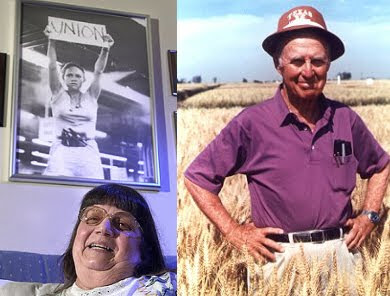
Crystal Lee Sutton and Norman Borlaug

Crystal n Norm


Crystal Lee Sutton died on September 11th of cancer at 68. Norman Borlaug died the next day, also of cancer, aged 95. I'll admit I'd never heard of either. Crystal Lee Sutton, the real life inspiration for Martin Ritt's Carter-era film Norma Rae-- I just assumed she was fictional, but she was real, and apparently the most famous scene from the film really happened:

She received threats and was finally fired from her job. But before she left, she took one final stand, filmed verbatim in the 1979 film Norma Rae. “I took a piece of cardboard and wrote the word UNION on it in big letters, got up on my work table, and slowly turned it around. The workers started cutting their machines off and giving me the victory sign. All of a sudden the plant was very quiet…” Sutton was physically removed from the plant by police, but the result of her actions was staggering. The Amalgamated Clothing and Textile Workers Union won the right to represent the workers at the plant on August 28, 1974.

-from her website, www.crystalleesutton.com


I don't know if you can film something verbatim per se, but that's a trifling objection. According to the Institute for Southern Studies


Several years ago, Sutton was diagnosed with meningioma, a type of cancer of the nervous system. While such cancers are typically slow-growing, Sutton's was not -- and she went two months without potentially life-saving medication because her insurance wouldn't cover it initially. Sutton told the Burlington (N.C.) Times-News last year that the insurer's behavior was an example of abuse of the working poor:

"How in the world can it take so long to find out [whether they would cover the medicine or not] when it could be a matter of life or death," she said. "It is almost like, in a way, committing murder."


Though Sutton eventually received the medication, the cancer had already taken hold. She passed away on Friday, Sept. 11 in a Burlington, N.C. hospice.


Norman Borlaug was also an incredible person, albeit of a very different cast. After receiving his PhD at the age of 28 he went to work for the US military in WWII, first developing a saltwater-resistant adhesive that allowed US forces to jettison watertight boxes of canned food to troops stranded on Guadalcanal island. In the years after the war he was instrumental in developing disease-resistant high yield crops that helped India be able to produce enough food to feed all her people.

He won the Nobel Peace prize in 1970, and consequently his passing made a lot more news than Sutton's. I don't mean that as sarcasm-- he certainly helped a lot more people. But also it occurs to me that although they were both humanitarians, his story, broadly speaking, has a certain uncomplicated quality, at least from the point of view of corporate news outlets. American scientist helps feed world, is justifiably celebrated, dies after a long rewarding life. Sutton's story is less rewarding for the corporate media to tell, because it is less sunny, underscoring the hostile legal climate that unions inhabit in the US, as well as our vanishing industrial base.(She worked in a clothes factory in North Carolina, and today most domestic clothes production has been exported out from under us.) Even the end, with her conflict regarding her insurance, is a story the corporate media isn't so eager to relate to us. Katie Couric didn't mention that last bit on the CBS news, but at least she mentioned her.

You can find less sunny aspects to Bourlag's story if you are really determined; he was an early proponent of DDT*, for example,but so were a lot of people. Nevertheless he was always trying to help people, and there's no question on balance he did, tremendously. Yes, Borlaug was a booster of genetically-modified foods. But at least until we can figure out how to feed everybody, stop raping the planet, and substantially shrink the world population(through as-yet undiscovered, ethically and socially doable means), I'd say his way is the right way for much of the third world, handily trumping lefty-doctrinaire objections.

I'm not keen on some of the particulars of corporate farming, like counterproductive US subsidies of ethanol or patenting seeds and telling third-world farmers they're intellectual property, but screwy consequences like that were not Bourlag's doing.

I don't have a penetrating, overarching point in discussing Sutton and Bourlag-- my blogging is often simply a record of efforts at my self-education, and I wanted to take note of their passing.


"*Food Security and Agriculture" by Devinder Sharma

Labels: , , , , , ,

Thursday, August 27, 2009

The Liberal Gipper

Teddy n Dennis 1971
www.reelectkucinich.com


My mother was in love with the Kennedy mystique, especially with JFK.And while I am close to Dennis Perrin's age, Dennis being similarly impressed with Teddy, I nevertheless have difficulty sharing his enthusiasm, or my late mother's. Dennis rightly notes Carter's rightward tilt, and certainly Carter started some of the unfortunate deregulation that Reagan subsequently kicked into high gear. All the same, I don't think Carter was as ideologically indistinguishable from Reagan as Obama seems compared to McCain-- and I wonder to what degree we have Teddy Kennedy's hubris in staying in the democratic race just past the bitter end to thank for Reagan being elected in 1980.

From my vantage point it seems that a lot of left-wing bloggers who frequently bash Obama, however right they may be in doing so, often have something of a tin ear when it comes to "less-sexy" domestic policy issues. If they praise Kennedy for being to the left of Carter and a "liberal lion", I can't help but think that they fail to see Kennedy's blindness in dealing with Obama and his wretched, poisonous, healthcare plan. The ancient Greeks used to say you could not judge the quality of a man's life until his very last breath. My primitive understanding of Western classical culture being what it is, I think they were talking about the private,personal quality of life the person experienced, as opposed to the person's public character, so it's an ill-fitting metaphor-- but I'll use it.

Yes, Ted Kennedy did some good things, like help foster the COBRA healthcare act, but he himself described universal healthcare as the cause of his life, and if you judge him by what he did to help usher it in towards the end, he blew it pretty badly.

Read his July 18th essay in Newsweek, also entitled "The cause of my life" in which he criticizes Jimmy Carter for what he calls his piecemeal approach in 1980, and says, regarding the current legislative effort, that "Incremental measures won't suffice anymore." But then Kennedy goes on to say he doesn't support a single-payer scheme because he feels it's impractical, and he does support a "public option", as well as individual mandates. (But hey, Carter's approach was piecemeal.)

Kennedy was dying and he knew it, but as far as I can tell he said nothing about the gradual gutting of the legislation over the course of the summer, nor anything about Obama's very public vacillation regarding his support for the public option. www.honorkennedy.com

Labels: , ,

Thursday, April 09, 2009

Gregorio de la Rosa, and his son

Raymondville, Texas:
Do you remember the Wackenhut corporation? Apparently they've changed their name and are now the GEO group, but they still run private prisons for a profit and they get themselves in hot water due to their employees' wanton or grossly neglectful behavior. They just lost in their attempt to persuade a Texas appeals court to overturn a 42.5 million dollar judgment for wrongful death:

Houston Chronicle, "Appellate court upholds judgment in inmate's death"

A Willacy County jury had ordered Wackenhut Corrections Corp., now known as The GEO Group, and Warden David Forrest to pay the civil judgment to the family of Gregorio de la Rosa Jr."We find that Wackenhut's conduct was clearly reprehensible and, frankly, constituted a disgusting display of disrespect for the welfare of others and for this state's civil justice system," the Thirteenth Court of Appeals said in last week's ruling affirming the Willacy County civil judgment returned in 2006.

De la Rosa died a few days before his expected 2001 release, when two inmates used padlocks stuffed into socks to beat him to death.

and, from The Brownsville Herald, a PDF of the 114 page opinion. (Raymondville is Deep South Texas, near Brownsville, which is right on the border with Mexico and one of the chronically economically-deprived areas in the state. In the Rio Grande Valley the recession isn't something new but a continuation of the Nixon/Ford era one. ( The Valley is also heavily Democratic, but this is Texas and you know, funding priorities being what they are-- what can you do? )

The Thirteenth Court of Appeals issued its opinion in the case of Wackenhut Corrections Corporation and Warden David Forrest versus Gregorio de la Rosa Sr. His son, Gregorio de la Rosa Jr., was beaten to death with a lock wrapped in a sock while he was an inmate at the Wackenhut private prison in Willacy County on April 26, 2001.

CLICK HERE for the 114 page opinion.

[post revised for clarity- JV]

Labels: , , ,

Wednesday, March 18, 2009

the politics of lyme disease

Sara Robinson of Orcinus has an exceptional essay on Lyme disease and the politics of restricting treatment, apropos of a recent shooting at a Baptist church in Illinois. It's a lengthy article, well worth reading in full. Here's an excerpt:

The shooter, Terry Sedlacek, had struggled for years with long-term, chronic Lyme disease, contracted after being bitten by a tick some years ago. Though this description of his symptoms seems extreme even among Lyme patients, his struggle to get treatment is an infuriatingly common one. The media debate over the role this disease may have played in the shooting has tapped into one of the most furious and tragic medical debates in modern medicine. On one hand: there are doctors on TV claiming that it's entirely possible that Lyme can create the kind of psychiatric problems that would lead to this kind of catastrophe. On the other are doctors saying that it's impossible -- Lyme is a relatively benign bacterial infection that's easily treated with a few weeks of antibiotics.

Infectious disease specialists-- represented by the Infectious Disease Society of American (ISDA) -- have for decades held to the firm position that Lyme is a spirochete that can be killed with a 28-day course of doxycycline. If you're still sick when the month is over, whatever you have isn't Lyme (and, in practice, is generally assumed to be psychosomatic). And this is true, as far as it goes: if you're lucky enough to catch the disease in the first few months after you're bit -- or you've got one of the many strains that's amenable to this treatment -- a short course of doxy usually does do the trick.


However, once some strains of Lyme get dispersed and embedded in the body's tissues, the standard treatment won't touch them. Worse: the standard Lyme tests won't, either, so the results will likely come back negative. The shady politics of how the approved Lyme tests were developed would take a whole separate post to explain; but suffice to say that they're only 70% accurate on their best day, which would make them patently unacceptable as a diagnostic tool were it any other disease. Far more accurate and sensitive tests are available, but insurance companies won't cover the $400 fee.

That's because the IDSA panel doesn't approve of these tests (even though the "controversial" proteins it tests for -- the only ones common to all Lyme strains -- are the same proteins some of these same doctors once tried to build a Lyme vaccine on). It also doesn't accept Lyme's shapeshifting nature; the existence of a chronic form of resistant Lyme that requires long-term treatment; the importance of seeking out and treating co-infections; or the neurological and cognitive issues it can cause. All of these facts are well-documented by the peer-reviewed science; but IDSA's Lyme panel has actually purged new members who brought these studies up for consideration.

All this is part of the background for the dueling doctor interviews we're seeing on TV this week.

The Great Divide
Why would ostensibly caring doctors be so resistant to accepting new and better data? As always, follow the money. The IDSA's minimalist view of Lyme is greatly favored by insurance companies, who really don't want to be on the hook for expensive testing or more than a month of treatment. On a broader note: they're absolutely terrified (with good reason) that Lyme could turn out to be another huge budget-busting epidemic like AIDS, and want to do everything they can to make sure they're not stuck with the bills for it. To that end, they've made sure that the ISDA's Lyme experts have been richly rewarded with grants, consulting fees, and so on for aggressively defending the narrowest possible case definition and the most limited treatment standards. For their part, IDSA's Lyme group has held up their end of the deal so reliably that last May, they became the first medical standards board in the history of American medicine to be successfully sued (by the attorney general of Connecticut, no less) for corruption.


I don't normally make a habit of quoting so extensively, but I want to encourage you to go read her essay in its entirety, here.

Cross-posted at Hugo Zoom.

Labels: , , ,

Sunday, March 15, 2009

Various items

Foreign Policy, March 2009, "The Worst Kind of Stimulus: why a global weapons boom is the last thing we need" by
Travis Sharp

from Fora TV[video]: Does the US Spend Too Much on Foreign Aid? - Peter Singer(longer version here).

??AIDS and Germ warfare [video]

Two items from 2007; I never posted them and they merit being noted:

Gary Farber discusses the reputation of Gregg Easterbrook, which he deems inflated.

CNN's Arwa Damon on prostitution in Iraq

finally, from Slate, Feb. 2003: "who's for the war, who's against it"

Labels: , , ,